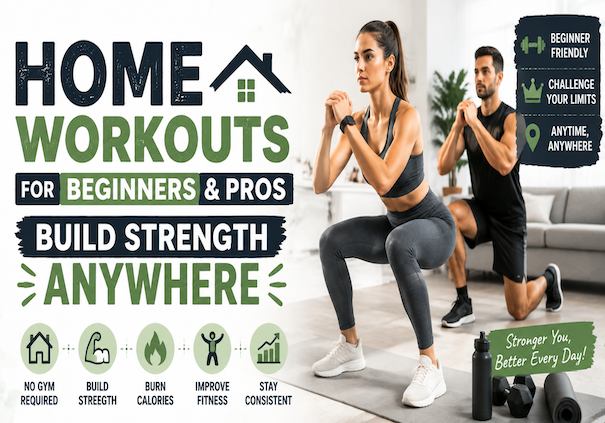
Staying fit and maintaining an active lifestyle no longer requires a pricey gym membership or an commute to a crowded fitness center. Modern home workouts have evolved into highly effective, science-backed routines capable of building muscular strength, improving cardiovascular health, and enhancing overall mobility from the comfort of your living room.
Whether you are pressed for time between work meetings, managing a busy household, or simply prefer the privacy of exercising at home, establishing a consistent home exercise routine is one of the most accessible steps you can take toward long-term physical wellness.
The Core Advantages of Transitioning to Home Workouts
Exercising at home eliminates the common friction points that cause most traditional fitness plans to fail. By bringing your fitness routine directly into your living space, you unlock several immediate advantages:
- Time Efficiency: Zero commute time means a 30-minute workout fits effortlessly into even the tightest schedule.
- Cost Savings: Eliminate monthly gym fees, parking expenses, and specialized workout attire.
- Ultimate Convenience: Train whenever it fits your energy levels—early morning, mid-afternoon, or late evening.
- Zero Judgment Environment: Master new movements and exercise forms at your own pace without feeling self-conscious.
Key Components of a Full-Body Home Workout
A well-rounded routine targets all major muscle groups through fundamental functional human movement patterns: pushing, pulling, squatting, hinging, and core stabilization.
To maximize progress with home workouts, incorporate these foundational bodyweight exercises into your weekly schedule:
1. Upper Body Pushing: Push-Ups
Push-ups are the gold standard for developing chest, shoulder, and triceps strength while simultaneously engaging your core. Beginners can start with wall or knee push-ups, while advanced individuals can elevate their feet for decline push-ups to increase intensity.
2. Lower Body Quad Dominance: Bodyweight Squats
Squats strengthen the quadriceps, hamstrings, glutes, and lower back. Focus on keeping your chest upright, driving your hips back, and pressing through your full foot as you return to a standing position.
3. Lower Body Posterior Chain: Glute Bridges and Hip Hinges
Working the backside of your body is critical for posture and lower back health. Glute bridges target the glutes and hamstrings directly, relieving stiffness caused by prolonged sitting during the workday.
4. Pulling and Upper Back: Inverted Rows or Resistance Band Pulls
Upper back strength is essential for preventing slouched posture. Using a doorway resistance band or pulling against a sturdy table edge allows you to target your lats and rear deltoids effectively without heavy weights.
5. Core Stability: Planks and Hollow Body Holds
Ditch traditional sit-ups in favor of isometric core holds. Planks build deep abdominal strength, protect your spine, and enhance total-body stability and immunity across all other movements.
Direct Comparison: Bodyweight Training vs. Minimal Equipment
| Workout Style | Equipment Needed | Best For | Progress Strategy |
| Pure Bodyweight | None (floor space only) | Absolute beginners, frequent travelers | Increasing reps, slowing movement tempo, harder variations |
| Dumbbell / Kettlebell | 1-2 adjustable weights | Muscle building (hypertrophy) | Increasing weight load, adding resistance to compound moves |
| Resistance Bands | Elastic loop/tube bands | Joint-friendly strength, rehabilitation | Switching to thicker bands, increasing time under tension |
3 Essential Rules for Maximizing Results at Home
Without a trainer or heavy weight racks, getting the most out of your home workouts relies on applying smart training principles:
- Apply Progressive Overload: To keep seeing physical improvements, your workouts must gradually become more challenging over time. Increase your total repetitions, shorten rest periods between sets, or slow down the tempo (e.g., lowering down for 3 seconds during a squat).
- Prioritize Proper Form Over Speed: Moving too quickly often leads to sloppy mechanics and potential injury. Focus on controlled, deliberate movements through a full range of motion.
- Maintain Consistency Over Intensity: A moderate 20-minute workout performed four times a week will yield far better long-term results than an exhausting two-hour session performed once a month.
Frequently Asked Questions (FAQs)
Can you really build muscle with home workouts without weights?
Yes. Muscle growth responds to mechanical tension, not the brand of equipment you use. By utilizing challenging bodyweight variations (like single-leg squats or decline push-ups) and training close to muscular fatigue, you can build noticeable muscle mass using only body resistance.
How often should beginners do home workouts?
For beginners, three to four 30-minute sessions per week spaced out with rest days (e.g., Monday, Wednesday, Friday) is an ideal structure. This gives muscles adequate time to recover and adapt between sessions.
What minimal equipment is best to buy for a home setup?
If you want to invest in a few budget-friendly items, a set of resistance bands and a pair of adjustable dumbbells offer the most versatility for targeting every muscle group.
How do I stay motivated when exercising at home?
Designate a specific, uncluttered space solely for working out, schedule your exercise sessions in your calendar like important appointments, and play an energetic playlist to signal to your brain that it is time to move.
Final Thoughts
Adopting consistent home workouts breaks down the barriers between you and your health goals. By focusing on fundamental bodyweight movements, practicing progressive overload, and staying patient with your progress, you can build a strong, capable body without ever stepping foot inside a commercial gym.



I play here every night after work and the wins keep rolling in. The app runs perfectly on my phone and deposits are instant. A must try for anyone looking for reliable entertainment. Jump on board via 99powlink
Chơi ở cricfy tv apk download thấy khá thoải mái, không bị tải chậm nhiều. TONY09-18
Cá nhân mình thấy netmirror phù hợp cho người mới vì giao diện dễ hiểu, đăng ký đơn giản và không mất nhiều thời gian làm quen. TONY09-18